Free toolNo signup · Nothing you type is sent
CAC calculator: what a new customer costs you
Enter what you spent on sales and marketing and how many customers you won, and get your customer acquisition cost and how many months of margin it takes to earn it back. Nothing you type leaves your browser.
- CAC and payback months
- Carries into the LTV calculator
- Share your numbers
Try it now
Change any number. The results update as you type.
Show your product as an interactive demo people can click through, free to get started.
Start for freeHow it works
Calculate customer acquisition cost
Enter what you spent on sales and marketing and how many customers you won, and get your customer acquisition cost and how many months of margin it takes to earn it back. Nothing you type leaves your browser.
Step 1
Enter spend and new customers
Put the total you spent to win customers in Sales and marketing spend, and the customers you won over the same period in New customers won.
Step 2
Add revenue and margin
Enter what an average account pays each month in Average revenue per account (monthly), and your Gross margin as a percentage.
Step 3
Read CAC and payback
Customer acquisition cost (CAC) is the cost of one new customer. CAC payback is how many months of gross profit from that customer it takes to cover it.
The example the tool opens with
The tool opens with one quarter of spend and wins for a subscription product. The walk-through below uses the same numbers.
- Sales and marketing spend
- $50,000
- New customers won
- 40
- Average revenue per account (monthly)
- $150
- Gross margin
- 80%
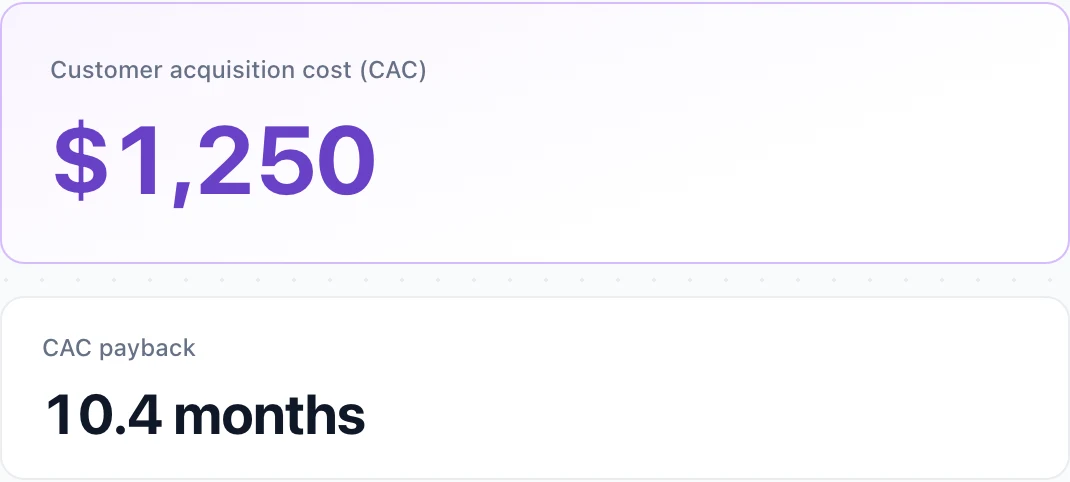
- Customer acquisition cost (CAC)
- $1,250
- CAC payback
- 10.4 months
How customer acquisition cost is calculated
The formula
Customer acquisition cost is the money spent on sales and marketing in a period, divided by the new customers won in that period.
Spend of $50,000 and 40 new customers gives $50,000 divided by 40, or $1,250 for each customer.
Payback period
CAC alone does not say whether a cost is affordable. Payback converts it to time: divide CAC by the monthly gross profit one account brings in.
An account paying $150 a month at an 80% gross margin yields $120 of gross profit a month. $1,250 divided by $120 is 10.4 months before that customer has covered what it cost to win.
Payback assumes the customer stays that long. A short payback with fast churn can still lose money, which is why the LTV calculator is a useful partner.
Blended CAC or paid CAC
Blended CAC divides total spend by all new customers, including those who arrived through referrals, word of mouth or organic search. Paid CAC divides only the spend on paid channels by only the customers those channels brought in.
Blended comes out lower whenever some customers arrive without paid spend, because it credits those customers to the whole budget. Paid CAC shows what the marginal customer costs when you buy more. Neither is wrong. The mistake is to switch between them from one report to the next.
What goes in spend
Count everything it took to win the customer: salaries and commissions for sales and marketing, advertising, agency fees, and the tools they use. Leaving out salaries makes a CAC look better than it is.
Match the periods. If a deal takes a quarter to close, this quarter spend produces next quarter customers, so dividing the two directly can mislead. Using a longer window smooths that out.
A published payback figure
The 2026 SaaS and AI Performance Benchmarks from Aleph and Benchmarkit, published 1 June 2026, report a median CAC payback of 16 months for calendar year 2025. The figure covers the 198 companies that reported it, out of 342 B2B SaaS and AI-native software companies surveyed (getaleph.com/answers/cac-payback-period-saas-2026, checked 2026-11-16).
It is a single median across company sizes, prices and sales motions, so it is a reference point and not a target. A product sold on a card in minutes and one sold through a long procurement cycle should not be held to the same number.
When the numbers are small
CAC is easy to distort over a short window. If you won four customers this month, one extra deal changes the figure by a quarter. Annual spend does not arrive evenly either: a conference, a campaign launch or a new hire lands in one month and pays off in later ones.
A quarter or a trailing twelve months gives a steadier figure. If you want it by channel, use the same rule for each one, and keep a line for spend you cannot attribute so it does not quietly disappear from the total.
Reading your result
Track CAC and payback over time, by channel where you can. A rising CAC with a flat payback means prices or margins rose with it. A rising payback with flat CAC means each customer is worth less to you each month.
See how Arclet tracks demo engagementFrequently asked questions
Everything you need to know to get started today.
More free tools
LTV calculator
Estimate customer lifetime value from revenue, margin and churn, and compare it with CAC.
Win rate calculator
Work out your win rate and how many deals you need to work to hit a revenue target.
NRR calculator
Calculate net revenue retention and gross revenue retention from a customer cohort.
All free tools
Every screenshot tool on one page.
Screenshots show a moment. Demos show the whole flow.
Record a workflow once in your browser and share a demo people can click through.