The condition
Most writing about interactive demos argues that they are good. That is not a useful claim, because
it is not falsifiable and it does not help anyone decide anything.
The useful version is conditional. Assuming you have already settled what an
interactive product demo is, one pays off when three things are true
at once:
The workflow is short enough to finish. As a rule of thumb, a handful of meaningful steps rather
than a dozen. Past that, completion falls away, and an abandoned demo has taught the viewer that
your product is long. Arclet's analysis of 600 public interactive product demos puts a number
against that rule of thumb: among the 555 demos whose player structure could be read, the median was
14 steps across 14 screens, with a 75th percentile of 22 steps. The longest measured demo ran 180
steps. Treat the median as the design question, not the target, and the 180-step outlier as a
warning about how a demo grows past finishable one screen at a time. The full breakdown is in
interactive product demo examples: what 600 public demos reveal.
It is visual enough to follow. The value has to be visible on screen. If the interesting part is
a number changing in a report, that works. If the interesting part is that the sync ran correctly at
3am, there is nothing to show.
It is asked about often. The whole economic case rests on recording once and answering many
times. A workflow that comes up twice a quarter does not repay the maintenance.
All three. Two out of three is where demo projects quietly die.
What a good candidate looks like
Concretely: someone wants to know whether they can build a report that shows a specific thing. The
steps are visible, there are maybe five of them, the payoff is a populated dashboard, and hundreds
of people have the same question.
That is the shape. Short, visible, common, and ending somewhere recognisable. The format choice for
it is a separate question, covered in
types of interactive product demos.
What a bad candidate looks like
The demo on this page is deliberately a bad candidate, and it is more instructive than a good one
would be.
Reconnecting a broken data source is real work that real people do. It is also almost everything you
do not want in a demo. Nobody evaluating a product wants to watch a repair. The interesting part is
whether it worked, which happens elsewhere and later. The screens are dialogs and status text. And
the person who needs this is already a customer with a specific broken thing, so a generic replica
does not address their actual problem.
Three failure patterns generalise from it.
Configuration and repair work. Setup, permissions, integrations, error recovery. Necessary,
unglamorous, and better served by documentation, which is searchable and cheaper to keep correct.
Anything depending on the viewer's own data. The honest answer to "would this work with my
data" is a trial, not a replica. A demo that implies otherwise is making a promise the format cannot
keep.
Anything that changes faster than you can recapture. If the screens move monthly and recapture
takes a week, you are shipping a demo that is wrong more often than it is right.
Maintenance is the real cost
The launch cost is visible and gets budgeted. The maintenance cost is invisible and does not.
A demo is a photograph of one release. Every product change that touches a recorded screen degrades
it, silently, with no failing test and no alert. The failure mode is not a broken demo. It is a demo
that still works and no longer tells the truth, which is worse, because a prospect who spots the
mismatch has learned something about how carefully you maintain things.
Before building, someone has to own recapture. Not "the team will keep it fresh". A person, and a
trigger that tells them when.
A five-question fit test
Answer for the specific workflow you have in mind.
- Can someone finish it in under two minutes?
- Is the value visible on screen, rather than inferred?
- Do more than a handful of people ask about it each month?
- Will the screens survive the next quarter without a rebuild?
- Is there a named person who will re-record it when it drifts?
Five yeses and you have a good candidate. A no on question three means the effort will not repay
itself. A no on four or five means you will ship something that becomes misleading, and it would be
better to write the documentation instead.
There is no shame in the answer being no. The support-cost problem that makes people reach for a
demo can often be solved better by fixing the confusing screen, and a demo that papers over a
genuinely bad interface is expensive camouflage.
Documentation wins for configuration, troubleshooting, and anything a reader wants to search
rather than watch.
A free trial wins when the real question is whether the product works with the viewer's own
data, which a replica structurally cannot answer.
A live call wins when the deal is large, the requirements are unusual, or the buyer needs to ask
a question nobody anticipated. A recording cannot be interrogated.
An in-product tour wins when the person has already signed up. The distinction matters enough
that it has its own page:
interactive demos versus product tours.
A short video wins when the story matters more than the proof.
A note on the deflection argument
I built Arclet partly because the same product questions kept arriving in Slack, and it seemed
obvious that a good self-serve answer would cost less than answering by hand each time. I still
believe poor self-serve guidance creates support cost.
That is a belief, and it is worth flagging as one. I am not going to put a percentage on it, because
I do not have evidence held to a standard that would make the number mean anything, and a
confident-sounding statistic here would be exactly the kind of claim this page is arguing against.
Arclet's own analysis of 600 public demos found no publicly observable engagement data for any of
them; the study measured what demos look like, not what they deflect, and it is honest about that
gap rather than papering over it with an invented number.
If you want to test it, the honest version is to instrument one workflow, publish one demo, and
watch whether the question stops arriving. If deflection is your primary goal rather than
acquisition, support use cases is the more directly relevant page.
Just start with a workflow that passes the fit test. Everything else is downstream of picking the
right one.
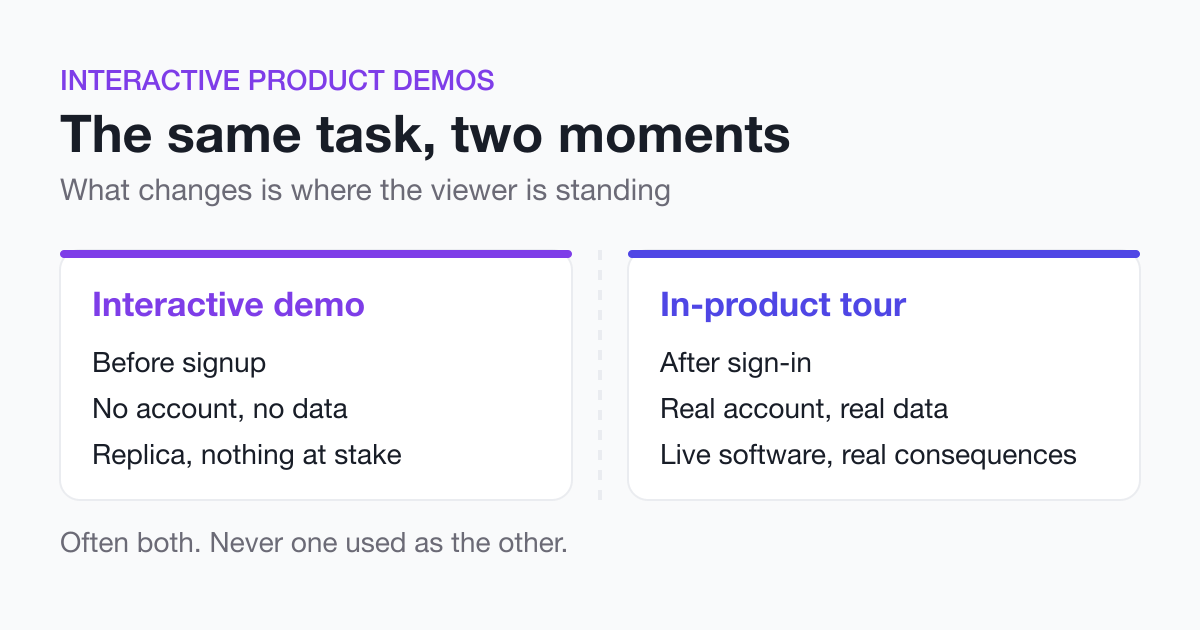 Interactive Demos vs Product ToursLearn the difference: an interactive demo runs before signup, a product tour runs after sign-in. Same task, different moment, different rules.
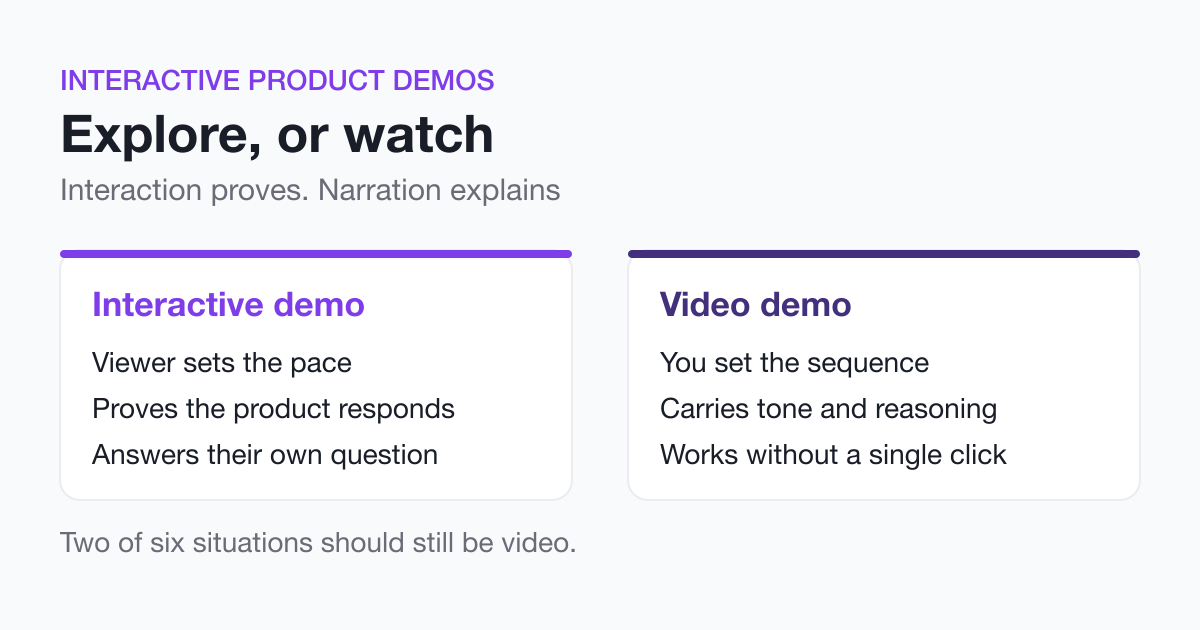 Interactive Demos vs Video DemosLearn when to choose interaction over narration. Interaction proves the product responds, video controls the story. Includes when video still wins.
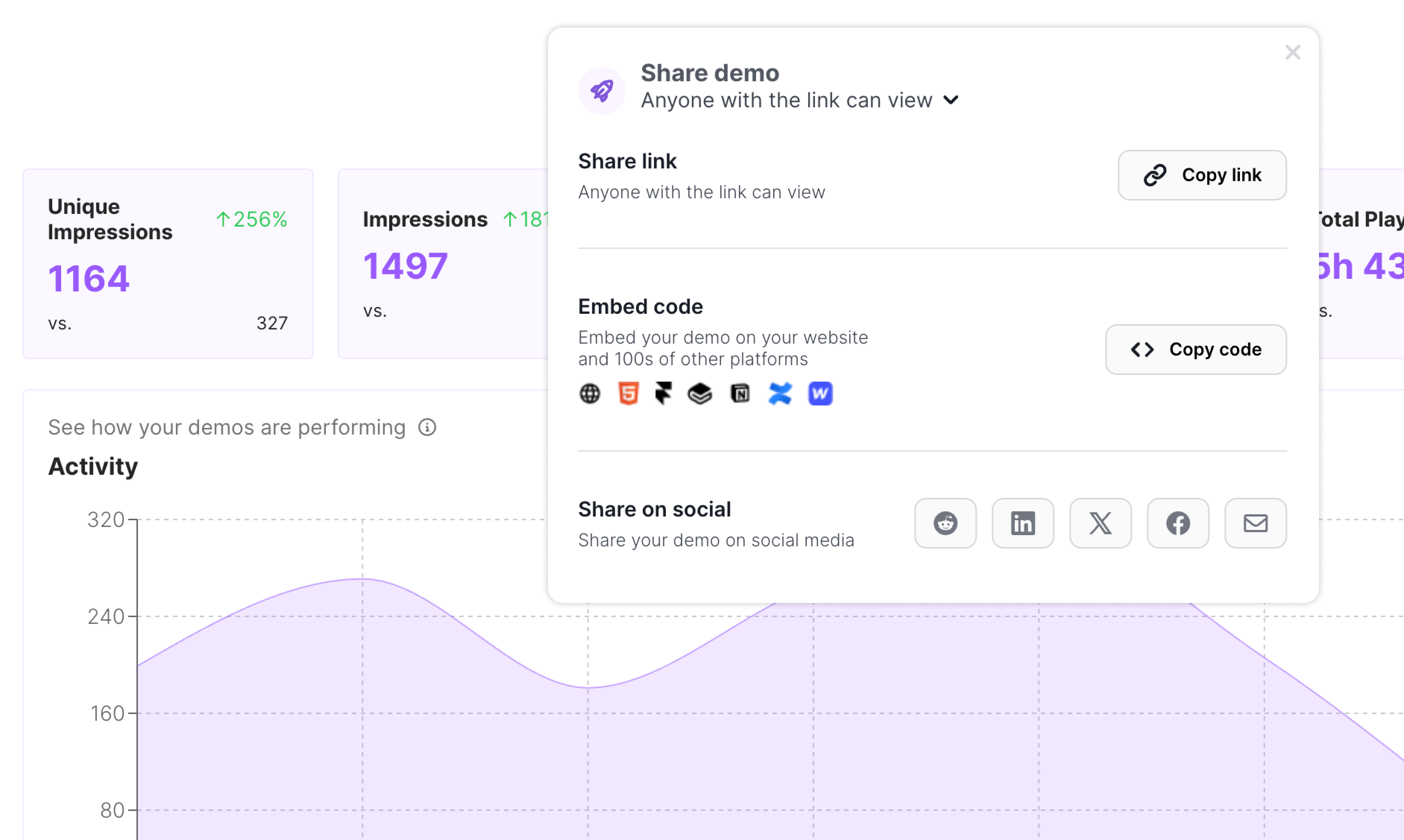 Interactive Support Walkthroughs for Help TeamsHelp support teams turn repeat questions into guided interactive walkthroughs for articles, ticket replies, macros, and self-serve answers.