Three axes, not a ranking
There is no best format, which is inconvenient for anyone who wants a recommendation in one line.
There are three properties, and every format is a different position on all three at once.
Fidelity is how closely the experience resembles the running product. High fidelity means the
viewer believes what they are seeing. Low fidelity means they are getting the idea rather than the
article.
Effort is the build plus the maintenance. Maintenance is the axis people forget, and it is the
one that decides whether a demo still exists in a year.
Freedom is how much the viewer chooses. Low freedom means one live control per screen and a
predictable story. High freedom means the viewer can go somewhere you did not plan, which is more
convincing and much harder to keep correct.
These pull against each other. Raising freedom raises effort. Raising fidelity usually raises
maintenance, because a faithful replica breaks whenever the original moves.
Everything below assumes you have settled that an
interactive product demo is the right kind of asset at all. If you
have not read how interactive product demos work,
the underlying parts are explained there and this page will make more sense afterwards.
Arclet analyzed 600 public interactive product demos, and visual format was measurable for 270 of
them. Within that measured subset, 123 used video, 98 used a mix of image and video, and 49 used
image-only screens. The other 330 demos in the cohort did not expose format reliably, and that gap
stays a gap rather than a guess: unmeasurable is not the same finding as image-only or video-only.
Read the numbers as what they measure, not more. The finding is not that video appears in 123 of all
public demos. It is that video appeared in 123 of the 270 records where format could be identified
at all. The full breakdown, including how the extraction handled unknown format, is in
interactive product demo examples: what 600 public demos reveal.
Guided screenshot walkthrough
A sequence of captured images with an instruction layer on top. The viewer clicks to advance, and
the click usually lands on the control the caption is discussing.
Fidelity is moderate: the screens are real, but nothing behaves. Effort is the lowest of the four.
Freedom is minimal by design.
This format is underrated, mostly because it is unglamorous. It survives product changes better than
anything else on this page, because a stale screenshot still communicates while a broken replica
does not. When the workflow is short and the goal is comprehension rather than conviction, it is
frequently the right answer and the cheapest one.
It is a poor choice when the point you are making is that the product feels good to use. Images
cannot carry that.
DOM replica
A capture of the page structure rather than a picture of it. Text stays sharp, copy can be edited
after recording, and controls can be made to respond in ways that feel close to the real thing.
Fidelity is high. Freedom can be moderate to high. Effort is where it gets interesting: the initial
build is not much worse than a walkthrough, and the maintenance is considerably worse, because the
replica is coupled to markup that the product team changes without telling you.
Choose this when the interface is the argument, and when someone owns keeping it current. Avoid it
for a product under heavy UI churn, where you will spend more time repairing the demo than anyone
spends watching it.
Branching path
A demo with real forks, where a viewer choosing differently reaches a genuinely different screen
rather than being nudged back.
Fidelity is high, and freedom is high in the specific way that matters: the viewer gets to test
whether the product does what they, personally, need. That is the closest a demo comes to answering
an individual's question.
Effort is high and, importantly, it multiplies rather than adds. Two branch points can mean four
end states to capture, review and maintain. Every branch also inherits the staleness of everything
else.
This format earns its cost when your audience is genuinely segmented and the segments care about
different things. It is wasteful when everyone is asking the same question, which is worth checking
before you commit to the format rather than after.
Sandbox-style task
A constrained replica where the viewer is given a task and left to complete it more or less however
they like.
Freedom is the highest available. Fidelity is high. Effort is high and the risk is different from
the other three: you lose control of the narrative. Some viewers find the thing you wanted them to
see. Others wander and conclude the product is confusing, which may even be accurate.
Use it when self-directed discovery is the point, when the audience is technical enough to enjoy
poking at things, and when you can afford to let some viewers get lost.
Choosing
Scroll to see every column.
Choosing comparison
| Format |
Fidelity |
Build effort |
Maintenance |
Viewer freedom |
| Guided screenshot walkthrough |
Moderate |
Low |
Low |
Low |
| DOM replica |
High |
Moderate |
High |
Moderate |
| Branching path |
High |
High |
High and multiplying |
High |
| Sandbox-style task |
High |
High |
High |
Highest |
Three rules that hold up in practice.
Start one step cheaper than you think you need. The gap between a walkthrough and a branching
path is mostly felt by the person who built it. Viewers notice a demo that is out of date long
before they notice one that is simple.
Match freedom to how varied your audience actually is. Branching is worth it when people arrive
with genuinely different questions. If everyone wants the same answer, freedom is cost with no
return.
Budget maintenance before you pick. If nobody owns re-recording, choose the format that degrades
most gracefully, which is the walkthrough.
Whichever format you land on, the build starts the same way:
Arclet records a browser workflow as editable steps, then you decide how
much branching or freedom to layer on top.
A quick calibration exercise: open interactive product demo examples: what 600 public demos
reveal, pick three from the
findings, and decide which of the four formats each one is. Then ask whether it needed to be that
one. The answer is frequently no, and spotting that in someone else's work is much easier than
spotting it in your own.
If you are still deciding between an interactive format and a narrated one rather than between the
four here, that comparison is on
interactive demos versus video demos.
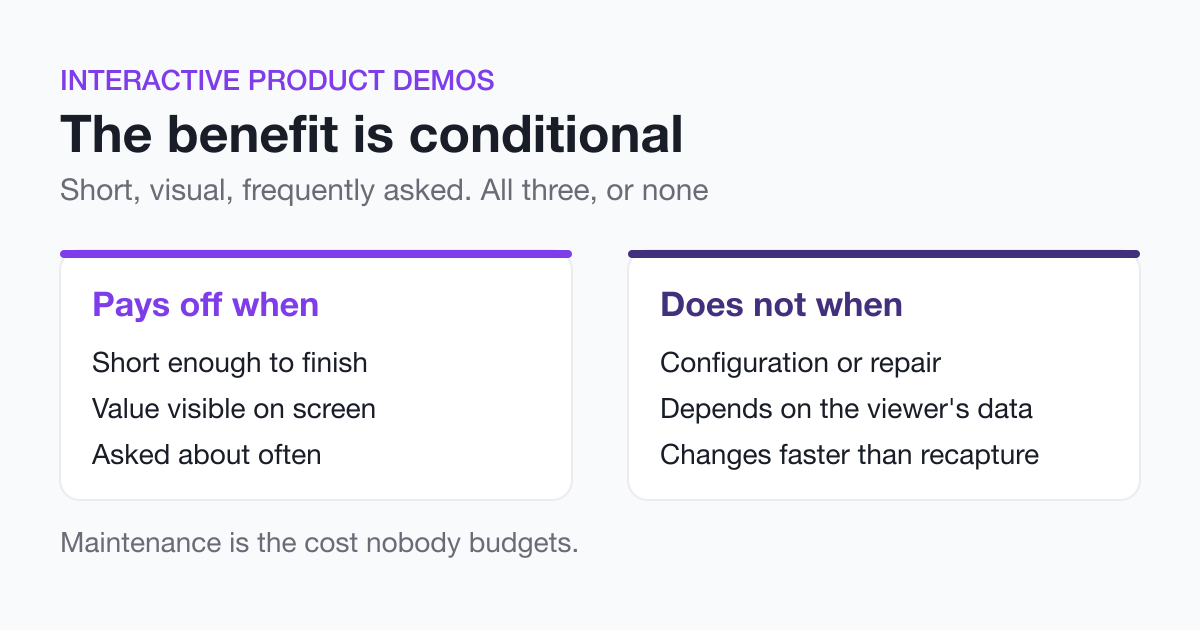 Interactive Product Demos: Benefits and LimitationsLearn when an interactive demo pays off: short, visual, frequently asked workflows. Plus the maintenance cost and the cases where you should not build one.
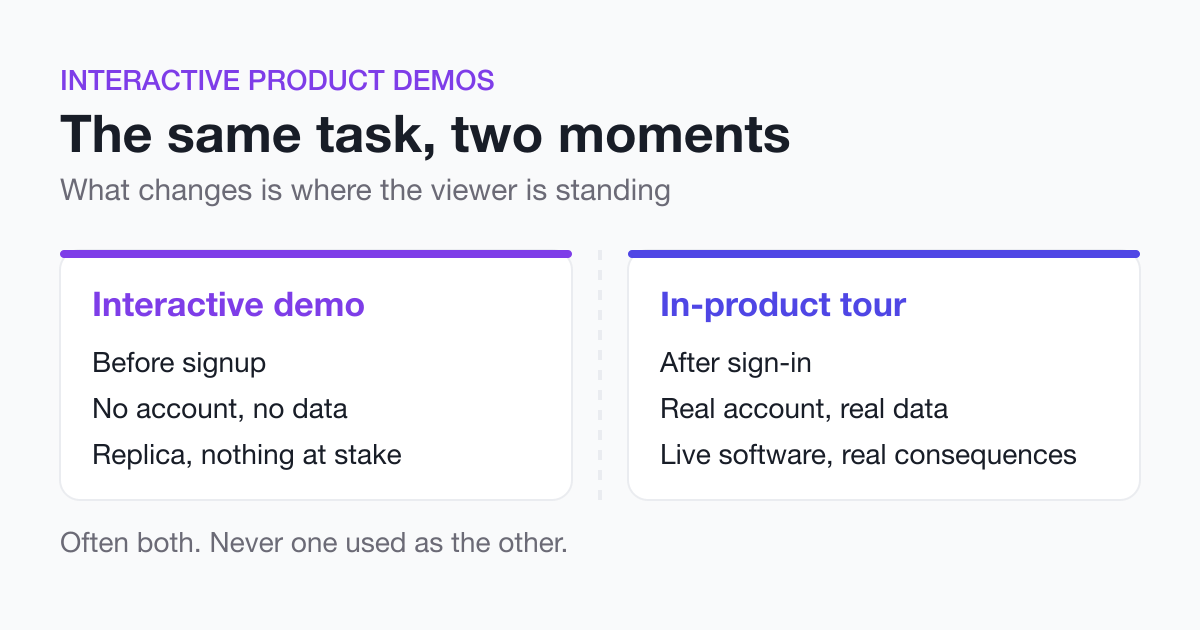 Interactive Demos vs Product ToursLearn the difference: an interactive demo runs before signup, a product tour runs after sign-in. Same task, different moment, different rules.
 Interactive Sales Demos for Buyer Follow-UpCreate interactive sales demos buyers can explore before meetings, share with stakeholders, and revisit after every follow-up conversation.