What each one is actually good at
This gets argued as a trend, usually by someone with an interest in the answer. It is better treated
as two tools with different properties.
Interaction lets a viewer answer their own question. They click the thing they care about,
in the order they care about it, and they get proof that the interface responds. Nobody chose the
path for them, which is exactly why the conclusion sticks.
Narration controls sequence. You decide what comes first, what gets emphasis, and what the
viewer is told to think about it. A voice carries tone, and tone carries things a replica cannot:
confidence, humour, the sense that a person built this.
Interaction proves. Narration explains. Most arguments about which is better are arguments about
which of those two the situation needs. If the term
interactive product demo is itself doing unclear work here, the
category definition settles it in a paragraph.
One story, told both ways
Take teaching a reporting narrative: the walk from raw numbers to a report a team can act on.
As an interactive demo, the viewer builds it. They click through, watch the report assemble, and
finish having done the thing. What they take away is that it is doable and not complicated. What
they miss is the reasoning, unless the guidance copy is unusually good, because tooltips are a
narrow channel for argument.
As a narrated video, someone explains why this metric matters, why the default view is wrong,
and what a good report looks like. The viewer takes away understanding. They do not take away proof
that the product is quick to use, because they never touched it.
Notice that these are not competing versions of one asset. They deliver different things, and a team
that can only afford one should pick based on which of those two they need.
When video is the better choice
When the story matters more than the proof. Explaining why a category is broken, or what your
product is for at all, is narration work. An interactive demo of an idea is not a thing.
When the audience will not click. A conference room, a LinkedIn feed, an email that gets read on
a phone in a lift. Assets that must work passively should be passive.
When the product is not ready to be shown responding. If the interface is mid-rebuild or the
workflow takes eleven steps, video lets you cut. A demo cannot cut, and it is honest about that in a
way that is not always in your interest.
When the value is not on screen. If the interesting part is something that happens overnight or
inside a system with no interface, there is nothing to interact with, and a diagram with a
voiceover explains it better.
When you need it this week. A competent screen recording with narration takes an afternoon. A
demo takes longer and needs an owner afterwards.
When interaction is the better choice
When the objection is disbelief. "It cannot be that quick." Clicking through it in ninety
seconds settles that argument in a way no video does, because the viewer supplied the clicks.
When the audience is segmented. Different visitors want different parts. A demo lets them pick.
A linear video makes everyone sit through the other segments' sections.
When the thing you are selling is that it feels good to use. Interaction is the only format that
can carry that, and it is the reason the format exists at all.
When you want the viewer to have done something. Someone who completed a workflow has a
different relationship with the product than someone who watched one. That is worth more than the
production polish they gave up.
Cost over a year, not at launch
Comparing launch cost makes video look expensive and demos look cheap, which is backwards over any
useful horizon.
A video is expensive once and then stable. It goes out of date visually but it does not break, and a
slightly old interface in a video reads as a slightly old video.
A demo is cheaper once and then permanently owned. It degrades every time the product changes, it
degrades silently, and the failure mode is that it still works while no longer being true. Fifteen
years of maintaining software has left me fairly confident that anything with a silent failure mode
costs more than the estimate.
The practical version: if nobody owns recapture, the video is cheaper over a year even though it
costs more today.
What the public data does and does not show
Arclet analyzed 600 public interactive product demos. Format was measurable for 270 of them: 123
used video, 98 mixed image and video, and 49 used image-only screens. That tells you video is a
common choice among demos where format could be identified at all. It does not tell you which choice
converts better, because no engagement data was publicly observable for any demo in the cohort.
Nobody has published the completion or conversion numbers that would settle a format argument on
data rather than on the reasoning above. The full breakdown is in
interactive product demo examples: what 600 public demos reveal.
A decision guide
Scroll to see every column.
A decision guide comparison
| Situation |
Choose |
| Explaining why the problem matters |
Video |
| Proving the workflow is as quick as you claim |
Interactive demo |
| Asset that must work without clicks, in a feed or a meeting |
Video |
| Visitors arriving with genuinely different questions |
Interactive demo |
| The value happens off screen or overnight |
Video |
| The objection is that the product looks hard to use |
Interactive demo |
Two of the six are video, and that is not a hedge. If you never reach for narration, check whether
you are solving the top row with the wrong tool.
If you have decided on interaction and now need to pick a format, that is
types of interactive product demos.
If the person you are trying to reach has already signed up, neither of these is the question, and
interactive demos versus product tours
is. For the wider case on where these assets sit in acquisition,
marketing use cases has it.
 Interactive Product Demo Examples: What 600 Demos RevealArclet analyzed 600 public interactive product demos for length, guidance, interaction and format. See what the first-party data shows.
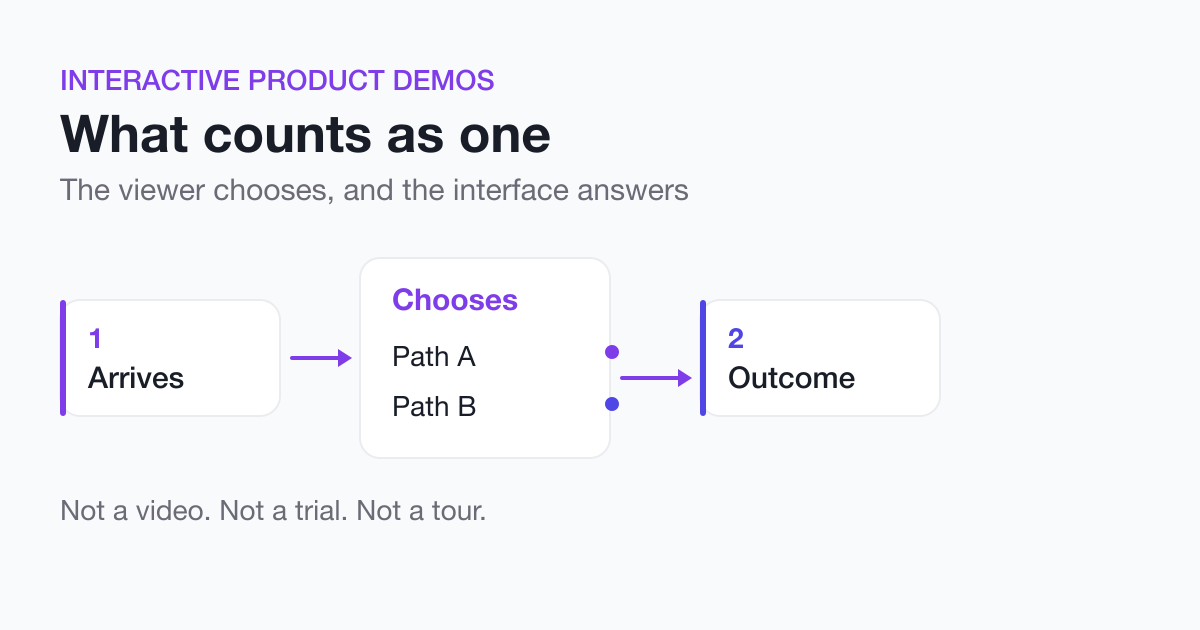 What Is an Interactive Product Demo?Learn what an interactive product demo is: a self-directed replica of a real workflow anyone can click through before signup. What counts, and what does not.
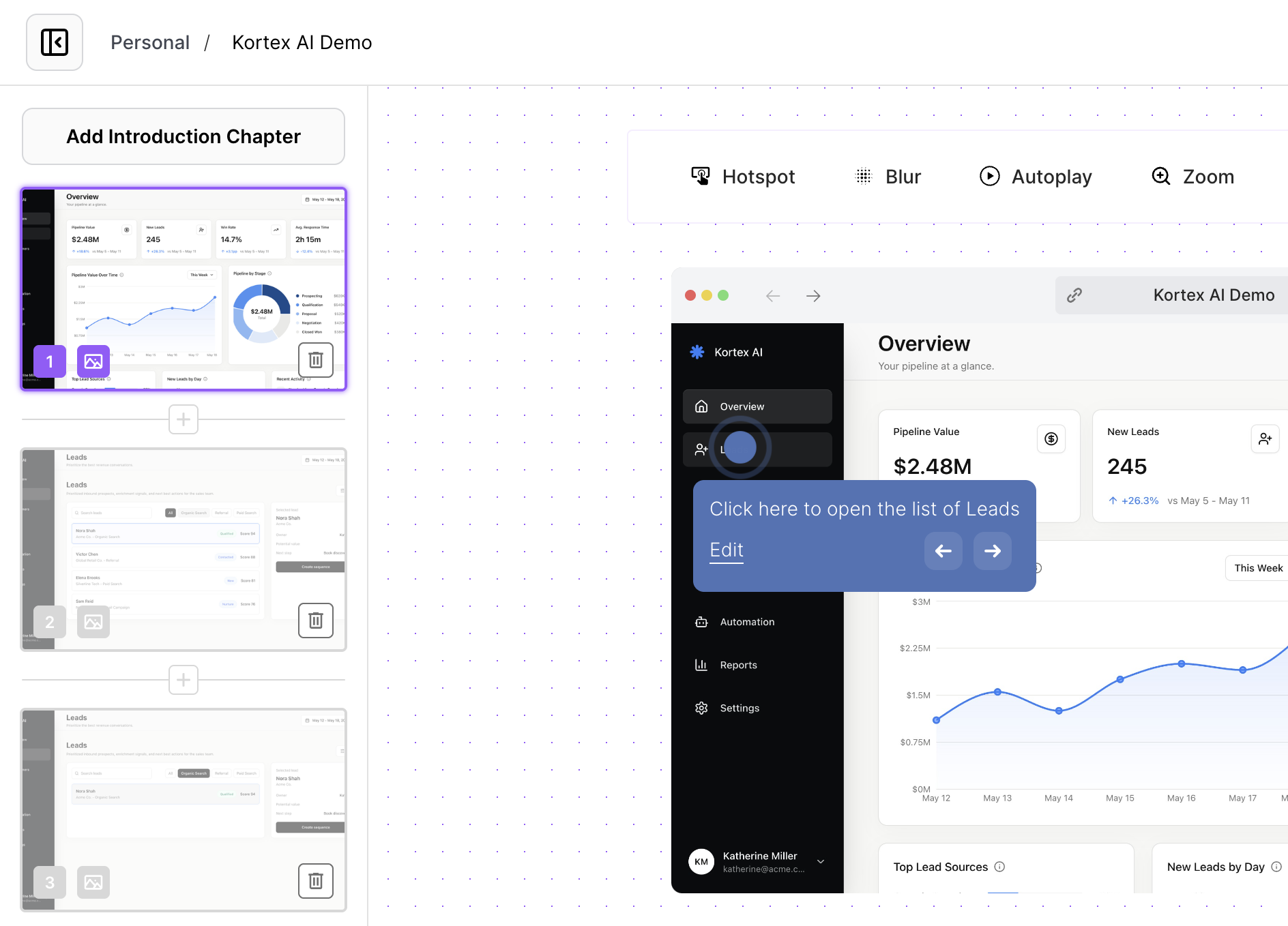 Interactive Training Demos for Workflow PracticeCreate interactive training demos for SOPs, onboarding, enablement, customer education, and replayable process lessons online.